Product Sections

Main Pages

New Products

Tru-Pull® Lite Knee Brace

Tru-Pull® Lite Knee Brace

£84.99

Click on the image for instructions on how to size the knee brace for your patient.

For anterior knee pain the patented Tru-Pull® Lite System is the latest in the range of patella braces are designed to exert a dynamic pull on the patella during knee flexion and extension. It was born of a demand for a lighter brace for use in competitive sports.
find out more

Best Sellers

Aircast Sock

Aircast Sock

£9.99

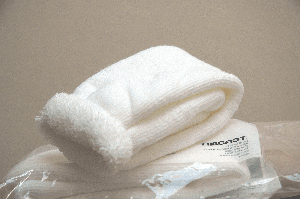
When you are going to live with your XP Walker for more then the treatment time you expected you are going to need an extra sock. When you have enjoyed the comfort of the Aircast Sock that comes with your Walker then nothing else will do.

We have the original Aircast Sock which are sold as one sock in an airtight bag. Order as many as you like the postage and packaging is the same for 5 as for one!
find out more

Aircast Air-Stirrup® Ankle Brace

Aircast Air-Stirrup® Ankle Brace

£45.99

Click on the Aircast Air-Stirrup® Ankle Brace image to help with your patient's choice of size of this ankle brace following ankle injury.

Since 1978, the Aircast Air-Stirrup® Ankle Brace has been the "standard of care" for the functional management of ankle injuries and has been cited in over 100 medical journals for its superior performance in helping to heal ankle injuries. This is the most prescribed ankle brace by the foot and ankle surgeons at the Sport and Orthopaedic Clinic in Bristol, UK.

Click the image for an explanation of the three things patients should look for in a good shoe to go with this brace by Mr Bill Harries a Consultant at one of the sporting world's most famous Sport and Orthopaedic Clinics.

find out more

Glossary

Online Catalogue |  Glossary

Acute Knee Ligament Injury

Acute Knee Ligament Injury

In the acute knee injury consider RICE (rest, ice, compression and elevation). pain and instability can be managed with crutches, the appropriate pain killers and a knee splint like the Super Knee Splint in the first instance. You should have several on the shelf of your practice for the first presentation of the patient. Some of these splints can be purchased in packs of 10.

This is an injury that requires reassessment for the class of ligament injury. Early referral through Accident and Emergency to an Orthopaedic and Trauma Service is mandatory for some grade 2 injuries and all grade 3 ligament injuries.

Acute Quadriceps Tendon Rupture

Acute Quadriceps Tendon Rupture

Quadriceps tendon rupture is often difficullt to diagnose and needs a high index of suspicion. There is a new radiological sign to help doctors with this diagnosis. (Hardy JR, Chimutengwende-Gordon M, Bakar I. Rupture of the quadriceps tendon: an association with a patellar spur. J Bone Joint Surg Br. 2005 Oct;87(10):1361-3. Erratum in: J Bone Joint Surg Br. 2006 Jun;88(6):837.)

In the acute injury consider RICE (rest, ice, compression and elevation). pain and instability due to the loss of the extensor mechanism can be managed with crutches and a knee splint like the 3-Panel Knee Splint in the first instance. You should have several on the shelf of your practice for the first presentation of the patient. Some of these splints can be purchased in packs of 10.

This is an injury that requires surgical repair. Early referral through Accident and Emergency to an Orthopaedic and Trauma Service is mandatory.

Acute Patella Dislocation

Acute Patella Dislocation

Patella dislocation is frequently difficult to diagnose. In the history as about the mechanism of injury and previous dislocation. Look for tenderness and bruising along the medial aspect of the patella from rupture of the medial retanaculum. There may or may not be an effusion. Look for Apley's aprehension sign. Look for the predisposing anatomical features for dislocation such as the patients sex, persistent femoral anteversion, the "Q" angle and any patella malalignment, maltracking or dysplasia.

In the acute injury consider RICE (rest, ice, compression and elevation). pain and instability and pain can be managed with crutches and a knee splint like the Three-Panel Knee Splint in the first instance. You should have several on the shelf of your practice for the first presentation of the patient. Some of these splints can be purchased in packs of 10.

This is an injury that frequently requires surgical repair. Five percent of all dislocations are associated with an osteochondral fracture like the one in the radiographs that was repaired with keyhole surgery. Early referral through Accident and Emergency to an Orthopaedic and Trauma Service is mandatory.

ACL Rupture

ACL Rupture

OrthopaedicsandTrauma.com asked Mr John Hardy about ACL injury and management. John is a Consultant Orthopaedic Surgeon in London and Bristol in the UK who performed over 105 ACl reconstructions between 1st January 2001 and 1st January 2007. He estimates that he has treated greater than this number of patients conservatively in the same period. John said " The important thing about assessing the patient with an ACL rupture is to undertake it early". "During early assessment, by a Consultant in Orthopaedics and Trauma, the ACL rupture pattern is characterised, complication of the injury such as medial collateral ligament injury and meniscal injury (which needs early intervention) are defined and a treatment plan is instituted with the emphysis on rehabilitation". He said that "The ACL rupture can be characterised into three patterns. These are the partially torn ACL (first image), the torn ACL that heals to the PCL (middle image) and the torn ACL that rolls forward causing permanent intermittent anterior pain and prevention of full extension (final image). When there are no complications of the injury there is no hard and fast rule regarding conservative management of an ACL rupture but it is my experience that the athletes with a partial tear or one which heals to the PCL are likely to get away with conservative management". Where as patients with a symptomatic and demonstrably unstable knee are most likely to have the third type of rupture. (click on the image to see an "active quadriceps sign" of an ACL rupture)

John told OrthopaedicsandTrauma.com " A Cochrane review of published research in 2005 showed there was insufficient evidence from randomised trials to determine whether surgery or conservative management was best for ACL injury in the 1980s, and no evidence to inform current practice.". Linko E, Harilainen A, Malmivaara A, Seitsalo S. Surgical versus conservative interventions for anterior cruciate ligament ruptures in adults. Cochrane Database Syst Rev. 2005;Apr 18;(2):CD001356.

"Whether you consider conservative or surgical management is best for your patient I think the most popular off the shelf brace used in my practice for adding some stability to the ACL problem knee is the Donjoy Armor with ForcePoint™ knee brace." said John.

Correcting Leg Length Differences

Correcting Leg Length Differences

As you are reading this you are likely to be interested in the long term consequences of limb length differences in your patients.

Recent gait analysis demonstrates that the shorter limb sustains a greater proportion of load and loading rates [White SC, Gilchrist LA, Wilk BE. Asymmetric limb loading with true or simulated leg-length differences. Clin Orthop Relat Res. 2004 Apr;(421):287-92.] It is likely that in the long term this leads to earlier degenerate changes in spine, hip knee and ankle.

To measure your patients leg length using a tape measure, measure from the inferior aspect of the anterior superior iliac spine (ASIS) to the inferior aspect of the medial malleolus of the ipsilateral (same) side (upper 2 images). This point beneath the anterior superior iliac spine is found easily by passing the start of the measuring tape up 1cm from the inguinal ligament to its origin at the ASIS. This measures real against apparent leg length. Performing each measurement at least twice is a valid non-invasive clinical measure.[Beattie P, Isaacson K, Riddle DL, Rothstein JM. Validity of derived measurements of leg-length differences obtained by use of a tape measure. Phys Ther. 1990 Mar;70(3):150-7.]

Inequality in leg length can be congenital (from birth or as a result of inequality in growth), acquired (as a result of injury) or iatrogenic (prescription of the wrong insole or surgical shoe). The problem with unequal leg lengths, congenital or acquired, is that it produces a curvature on the spine (scoliosis: lower 2 images). This leads to abnormally high and unequal pressures on the elements of the spine and ultimately over many years abnormal wear due to these unequal pressures. This can contribute to back pain.

So before you prescribe a patient any foot and ankle supports for longer than an arbitary 6 weeks please check your patient's leg lengths and advise them to adjust the unaffected side accordingly. Remember not to assume that your patient was born with equal leg lengths.

With this in mind it should be obvious that some patients need only one insole and other patients need equal thickness insoles and other patients need insoles of differing thickness.

Hoffa's Posterior Fat Pad Syndrome

Hoffa's Posterior Fat Pad Syndrome

The infrapatella fat pad is otherwise known as Hoffa's fat pad. The infrapatellar fat pad is commonly injured but rarely diagnosed as a cause of pain.

Injury is a frequent cause of anterior knee pain. Anterior knee pain is an umbrella term for many definable conditions.

Abnormalities within the infrapatella fat pad most commonly are the consequences of isolated injury (football) cyclic trauma (running) and degeneration. Inflammatory and neoplastic diseases of the synovium can be confined to the fat pad but are rare. Repetitive trauma can be seen on MRI of the fat pad as intrinsic signal abnormalities. This can occur with both posterior and superior impingement syndromes.[Saddik D, McNally EG, Richardson M. MRI of Hoffa's fat pad. Skeletal Radiol. 2004 Aug;33(8):433-44. Epub 2004 Jun 19.] The image of the MRI scan left is from the above paper on the MRI of Hoffa's fat pad and shows superior impingment as a cause of anterior knee pain. Click on the image to read on about this condition and its treatments.....

Lateral Collateral Ligament Injury

Lateral Collateral Ligament Injury

The Lateral Collateral Ligament of the knee is the narrow based ligament on the outside of the knee between the femur and the tibia. It is best felt with the patient's foot placed on the contralateral shin in a figure of 4. In this position it can be felt as a cord like structure between the head of the fibula and the lateral femoral condyle. It is injured infrequently. Usually with a force from the inside of the knee. Grade one ligamant injury (pain but no laxity) and grade 2 injury (pain and increased ligamant laxity with an end point) are treated conservatively with RICE (rest, ice, compression and elevation). Early ROM is important. So to enable this any one of the knee braces from the down can be used. Suggest your patient put one in a plastic bag and place it in the fridge over night for the first 72 hours to cool it down for the next day in order to apply ice.

Medial Collateral Ligament Injury

Medial Collateral Ligament Injury

The Medial Collateral Ligament of the knee is the broad based ligament on the inside of the knee between the femur and the tibia. It is injured frequently on its own. Usually with a twist or a force from the outside of the knee. Less frequently it is injured with the anterior cruciate ligament and the medial meniscus. This pattern of injury is known as O'Donahue's unhappy triad. Grade one ligamant injury (pain but no laxity) and grade 2 injury (pain and increased ligamant laxity with an end point) are treated conservatively with RICE (rest, ice, compression and elevation). Early ROM is important. So to enable this any one of the knee braces from the Drytex® Playmaker® down can be used. Suggest your patient put one in a plastic bag and place it in the fridge over night for the first 72 hours to cool it down for the next day in order to apply ice.

Meniscal Tear

Meniscal Tear

The image above is an arthroscopic view of a neglected meniscal tear. It was unstable. Therefore, it was causing pain when trapping between the condyles of the knee and secondary high pressure degenerate changes in the hyaline cartilage of the femoral and tibial condyles. The earlier the intervention for such symptoms the better the outcome.

A missed or neglected meniscal tear is the commonest cause of unicompartmental osteoarthritis in the knee. A meniscal tear like the one in the clip requires partial menesectomy and careful chondroplasty. How would you as a doctor advise on rehabilitation. Movement of the joint without excessive load is the best option. An off loading brace may help your patient with this. Make sure you order the OsteoArthritis brace rather than a knee ligament brace because the OA Adjuster or OA Lite type of brace loads the affected compartment in order to allow as much of the cartilage to recover as possible. Recommend that your patient does not use the sided brace on the other knee! Remember to consider the compartment of wear and when as the side, left or right.

Schuss Position

Schuss Position

This is the position in which the knee is flexed to 20° as in the skiing position. This allows the doctor to more acurately measure the affected side for brace fitting. Make a mark on the centre of the patella. Measure 15cm up from the centre of the patella and make and make another mark. Measure the thigh circumference at this point.

Have you have measured a limb in your patient that is wasted due to disuse? If you expect a rapid recovery of the normal muscle bulk of the thigh think about measuring the unaffected side to estimate the best size for your patient over the intervening period of recovery.

Knee Osteoarthritis

Knee Osteoarthritis

Osteoarthritis of the knee is due to degenerate changes that have occured in the hyaline cartilage on the surface of the bones. When one compartment is affected the cause is usually mechanical in nature. It begins with a traumatic or non-traumatic degenerate tear of the meniscus (left). It is usually the medial meniscus. The unstable portion causes high pressure degenerate change of the surface which in most cases progress to frank osteoarthritis within 2-10 years. The radiological diagnosis of osteoarthritis is loss of joint space, subchondral sclerosis, subchondral cysts and marginal osteophyte formation. The rate of this progression depends on a number of biomechanical factors. Depending on these factors, once the unstable meniscal tear and the unstable chondral damage has been treated you might recommend an OA Lite for the patient with advanced arthritis not yet ready for joint replacement.

Online Catalogue |  Glossary